
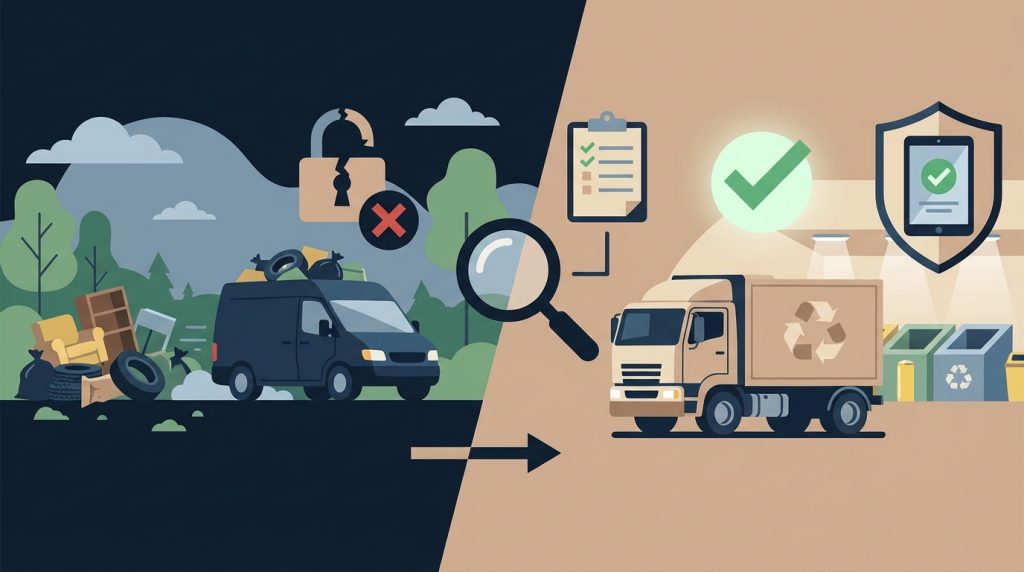
To stop yourself from getting stung by a rogue trader you need to verify their Upper Tier Waste Carrier Licence on the Environment Agency public register and insist on receiving a Waste Transfer Note before they drive off. If the person offering to take your junk demands cash upfront, drives a battered van with no company markings or refuses to give you a receipt then they are almost certainly going to fly-tip your waste. The only way to stay safe is to check the paperwork and never rely on a verbal agreement.
The reality of the mess out there
It is getting messy. I was reading the latest figures and they are honestly staggering. England recorded 1.15 million fly-tipping incidents in 2023/24 which is a 6.3% increase from the year before. It seems like everywhere you look there is a mattress or a pile of black bags just left on the side of the road. Councils are dealing with about 60% of this which turns out to be mostly household waste. That means it is regular stuff from people’s homes ending up in ditches.
Motorways aren’t safe either since they accounted for 37% of dumping sites. It is usually small van-load sizes but the big stuff is costing a fortune. There were 47,000 large-scale cases involving tipper lorries or bigger and that cost over £13 million to clear up.
In London the situation feels particularly tense. Fly-tipping is being driven by rising landfill taxes which are set to hit their highest point in April 2025. When it costs more to dump things legally rogue carriers see an opportunity to undercut legitimate firms. They offer a price that looks too good to be true because it is. Access issues at booking-only recycling centres also push people toward these quick fixes. It is a perfect storm really.
What a rogue trader looks like
You have probably seen them. They often drive white vans that have seen better days and lack any sort of logo or contact number. A legitimate business wants you to know who they are so they plaster their name everywhere. A rogue wants to remain anonymous.
They will almost always ask for cash. Cash is untraceable. If you pay cash and they dump your rubbish in a park there is no paper trail leading back to them. They might offer a quote that is half of what a professional company would charge. I know it is tempting especially when money is tight but you have to ask yourself how they are covering their costs. Disposal fees are high so if the price is low corners are being cut.
Another red flag is the lack of questions. A proper waste manager will ask what you have. They need to know if there is hazardous material or heavy rubble. A cowboy just wants to load up and go. They won’t offer a Waste Transfer Note which is a crucial legal document. Without that piece of paper you have no proof you disposed of your waste legally.
Why the fine lands on your doormat
This is the part that scares me the most. You might think that once the rubbish leaves your house it is no longer your problem. That is wrong. The law places a duty of care on you as the producer of the waste. If a rogue carrier takes your old sofa and dumps it three miles away the council will go through that rubbish to find evidence of where it came from.
If they find an envelope with your address on it you are liable. The fines are real. Households can be hit with a £400 fixed penalty notice just for failing to check if the carrier was licensed. If the case goes to court the fines can be unlimited. For businesses it is even worse with fines up to £50,000 and potential prison sentences.
It feels unfair. You paid someone to take it away so why should you be punished? But the logic is that by paying a rogue you effectively funded the crime. It is harsh but that is how the system works to force people to be careful.
Navigating the London landscape
London is a tricky beast when it comes to waste. The sheer volume is massive. The capital generates about 5 million tonnes of residual waste annually. About 1.59 million tonnes of that gets disposed of with a lot still going to landfill. The pressure is on.
Different boroughs have totally different stats. Brent had the highest residual waste at 186.8 kt while Kensington and Chelsea was way down around 10 kt. It shows how varied the city is. Some areas have great access to recycling centres while others are a nightmare of bookings and queues. This inconsistency makes it hard to accomodate the needs of every resident which is why so many turn to man-and-van services.
The London Plan 2016 had these ambitious targets for 100% waste management within the capital by 2026. They wanted zero biodegradable or recyclable waste going to landfill by then too. We are lagging behind. The reliance on disposal outside of London is still high. When you are looking for rubbish removal London has a lot of providers but the gap between the good ones and the bad ones is widening.
How to check the paperwork properly
It takes two minutes. That is it. Before you agree to anything ask for their waste carrier registration number. It should start with CBDU followed by a set of numbers. You can plug this into the Environment Agency public register to see if they are legit. If they don’t appear or the license has expired do not use them.
Once they arrive ask for the Waste Transfer Note. This document records what the waste is, who collected it, the registration number of the vehicle and where it is going. A legitimate company like Waste Management Group will provide this automatically. It is your receipt. Keep it safe for two years.
I always take a photo of the van and the registration plate too. If they are genuine they won’t mind. If they get defensive then you know something is up. Trust your gut. If it feels shady it probably is.
The wider impact of cutting corners
It is not just about the money. Julie Fourcade from FCC Environment put it well when she said fly-tipping is a blight on the countryside. She noted that with council budgets being tight the money spent clearing up mess could be better spent on initiatives to drive up recycling rates. Instead it is being wasted cleaning up after rogue operators.
Dan Cooke from CIWM also pointed out that each incident causes misery to local communities. It damages the environment and the local economy. I hate walking past a pile of dumped trash. It brings the whole area down. It attracts vermin and can be dangerous if there are chemicals or asbestos involved.
The government is trying to fix this. They are rolling out a Digital Waste Tracking Service. This will focus on waste receiving sites inputting data to enhance traceability. It aims to crack down on rogues by making it harder for waste to disappear from the system. It sounds promising but technology can only do so much if people keep paying cash to cowboys.
Better alternatives for your rubbish
You have options. The council tips are there even if they are a bit of a pain to book sometimes. For bulky items most councils offer a collection service for a small fee. It might take a week or two but it is safe.
If you need it gone fast look for licensed private companies. There are plenty of reputable firms offering rubbish removal London wide. They recycle a huge percentage of what they collect. They have insurance. They have staff in uniforms. It might cost a little more than the guy with the unmarked van but you are paying for peace of mind.
Think about donation too. If your furniture is decent charities might take it. It saves it from the landfill and helps someone out. We need to stop looking at waste as something to just get rid of and start thinking about where it goes.
Final Thoughts
I have been dealing with logistics and service industries for a long time and I have seen how easy it is to get caught out. You just want the junk gone. I get it. The garage is full or you are moving house and the stress levels are through the roof. But taking a shortcut with your waste is a gamble that rarely pays off.
The fines are one thing but the guilt of seeing your personal items dumped in a hedgerow is another. It takes a collective effort to stop these rogue traders. If we stop paying them they will go out of business. So check the license. Ask for the note. Keep your cash in your pocket until you are sure. It is a small effort that makes a massive difference to the city we live in.