
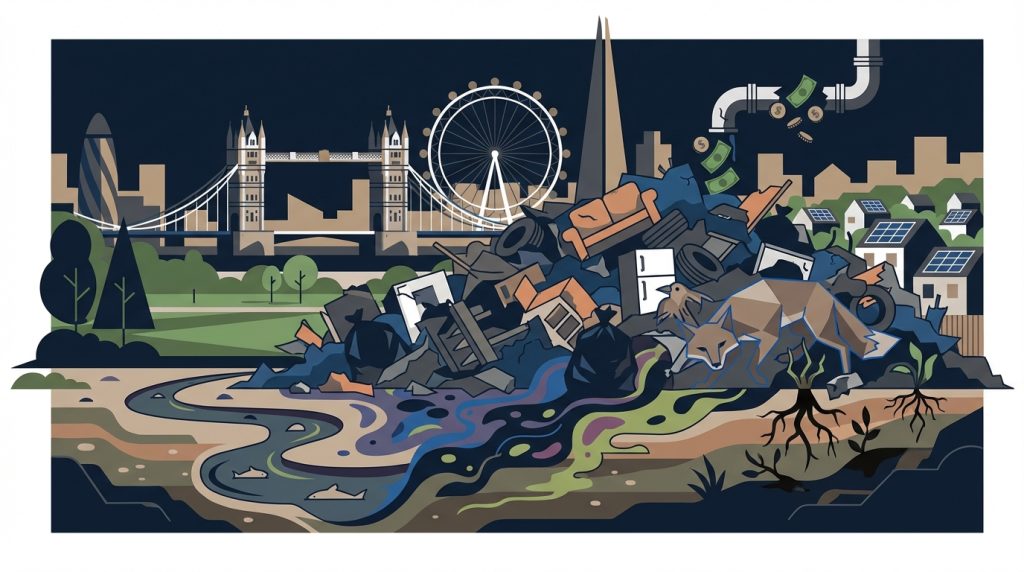
Fly-tipping is a deliberate environmental crime that poisons our soil, contaminates local waterways, and physically endangers wildlife across the capital. It drains millions of pounds from council budgets every year, money that should be fixing potholes or funding schools, and turns our neighbourhoods into dumping grounds.
At its core it is simply people and businesses dumping waste illegally to avoid paying disposal fees, and right now London is facing an absolute crisis with incidents rising and enforcement struggling to keep up.
I have worked in this industry for a long time. I have seen things that would make your stomach turn. It isn’t just about a few black bin bags left on a street corner. We are talking about tipper lorry loads of hazardous waste dumped in children’s playgrounds or beautiful green spaces.
It makes me angry. It should make you angry too.
The scale of the mess in London
You might think you know how bad it is but the numbers are actually terrifying. In the 2023/24 period alone fly-tipping incidents in England hit 1.15 million. That is a 6% increase from the year before. If you break that down it equates to one incident every 27 seconds. Think about that for a moment. By the time you finish reading this paragraph someone has probably dumped a load of rubbish somewhere they shouldn’t have.
London is taking the brunt of this. The density of our city seems to drive these rates through the roof. The City of London records 172 incidents for every 1,000 residents. That is the highest density but the sheer volume in other boroughs is staggering. Croydon is leading the pack with 35,470 annual cases. Camden isn’t far behind with 34,786 and Hackney has 33,464. These aren’t just statistics on a page. These are piles of mattresses and broken fridges and bags of rubble on our streets.
I remember driving through Croydon last month and seeing a pile of construction waste that must have been ten feet high. It blocks pavements. It blocks roads. It tells people that nobody cares about the area. And when an area looks like nobody cares crime tends to go up.
Ecological damage is worse than you think
We tend to focus on how ugly it looks. That is the immediate reaction. But the environmental impact goes much deeper than aesthetics. When household waste, which makes up about 60% of these incidents, is left to rot in the open it starts to break down. This releases a cocktail of chemicals into the soil.
If it rains those chemicals wash into the groundwater. I have seen waste dumped right next to canals and streams in places like Hackney. That pollution kills fish. It destroys the ecosystem that keeps our urban waters alive. It is a slow poison.
Then you have the danger to wildlife. Foxes and badgers and birds don’t know that a plastic ring holder is a trap. They rummage for food and get tangled or cut or poisoned. Large-scale dumping is even worse. We have seen a massive surge in “tipper lorry” size loads. These surged by 11% recently. This isn’t just a sofa. This is tonnes of material that might contain asbestos or plasterboard or industrial solvents. When that sits on the ground it leaves a toxic footprint that can last for decades.
Why is this happening right now
It comes down to money and laziness. It usually does. The cost of living is high and everyone is tightening their belts. I get that. But fly-tipping is a crime of avoidance. People want to get rid of their junk but they don’t want to pay the legitimate costs associated with proper disposal.
There is a rise in rogue operators. These are the “man with a van” types who advertise on social media offering to clear your house for twenty quid. If it sounds too good to be true it is. They pick up your rubbish & drive two miles down the road & dump it in a layby. They pocket your money and you are the one who could end up with a fine if the council traces the waste back to you.
It is frustrating because there are so many legal ways to do it. But these cowboys undercut the legitimate services. They don’t pay for licenses. They don’t pay landfill tax. They just dump and run. And because household waste incidents have rebounded to 60% of the total it is clear that regular homeowners are unwittingly fuelling this fire by handing their waste over to criminals.
The financial hit to our boroughs
This is the part that hurts your wallet even if you never fly-tip a day in your life. Cleaning up this mess is not free. In fact it is astronomically expensive. For those large tipper lorry loads alone the cleanup cost totalled £13.1 million in the last year. That is just for the big stuff.
Think about what £13.1 million could do for London. That is money for libraries. It is money for social care. It is money for parks. Instead it is being spent on shovelling someone else’s garbage off the street. Julie Fourcade from FCC Environment said it best when she noted that this money could be better spent investing in initiatives to drive up recycling rates.
David Gudgeon from Reconomy Connect called the data staggering. He pointed out that while taxpayers foot a bill of over £13 million for clearances authorities are only recovering about £730,000 in fines. The math doesn’t work. We are bleeding money. It is a necessary expenditure only because people refuse to follow the rules.
Enforcement is weak and ineffective
You would think that with all this money being lost the authorities would be cracking down hard. You would be wrong. The enforcement statistics are frankly pathetic. I don’t use that word lightly.
Only 5% of incidents result in a fixed penalty notice. That is 63,300 fines issued against 1.15 million crimes. But wait. It gets worse. Of those fines that are issued only 20% are actually paid. So if you do the maths we are looking at about one paid fine for every 100 incidents. If you are a criminal dumper those odds look pretty good.
London authorities have tried to get tough. They increased the maximum fixed penalty notice from £400 to £1,000 recently. They are adopting a zero-tolerance policy. But a high fine means nothing if you don’t catch the person doing it. Court fines are actually going down in number and the average fine is only about £530. That is often less than the cost of hiring a skip. Until the risk of getting caught is higher than the cost of legal disposal this problem isn’t going away.
How to spot the cowboys
This is where you come in. You have a legal “duty of care” regarding your waste. That means if you pay a guy to take your old kitchen away and he dumps it in a field you are liable. You can be prosecuted.
So how do you avoid this? You have to check for a waste carrier license. Every legitimate business has one. If they can’t show you a license do not let them take your rubbish. It is that simple. You need to look for a reputable rubbish removal company in London that has a track record, such as Waste Management Group. A professional service like Waste Management Group will always provide a waste transfer note. They will be transparent about where the waste goes.
Using a trusted partner like Waste Management Group protects you from prosecution. It ensures that your waste is recycled or disposed of safely. It keeps the chemicals out of the soil and the plastic out of the foxes. I know it might cost a bit more than the bloke on Facebook but the peace of mind is worth it.
Doing it the right way
There are alternatives. We don’t have to live like this. Most London boroughs offer bulky waste collection services. They can be a bit slow sometimes and you might have to wait a week but they are legal and they are relatively cheap. Recycling centres are available for those with a car.
I think we need to change our mindset about waste. We treat it as something to be banished instantly. Out of sight out of mind. But waste has a journey. When you throw something away “away” is a real place. It is a landfill or an incinerator or a recycling plant. Or if we are unlucky it is the pavement outside your house.
If you are doing a renovation or a big clear out plan the waste disposal before you start. Don’t leave it as an afterthought. Budget for it. Treat it as part of the project costs. If we all did that the demand for illegal dumpers would dry up. And if the demand dries up the supply will disappear.
The Bottom Line
I look at the streets of London and I see a city that is struggling with its own success. We have so many people and so much activity and inevitably so much waste. But turning our public spaces into trash heaps is not the answer. The environmental damage is real and it is cumulative. Every bag of rubbish adds to the toxicity of our ground and the cost to our councils.
It is easy to blame the council or the government and sure they could do more enforcement. But it starts with us. It starts with checking who takes your rubbish. It starts with being willing to pay the fair price for disposal. We all want a cleaner London. We just have to be willing to do the boring work to get it.